
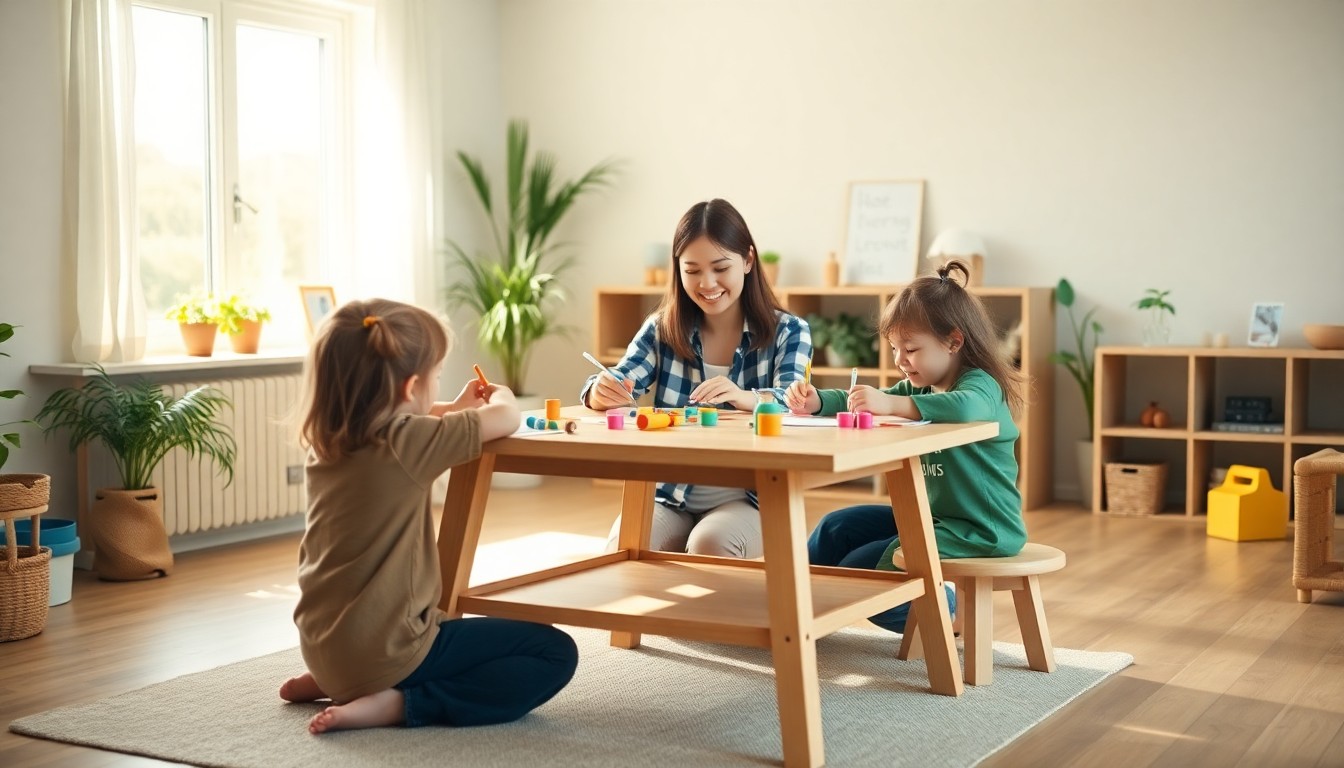
What actually happens between drop-off at 8 AM and pick-up at 5 PM in home-based childcare? It is the question every Auckland parent quietly worries about, and one that providers often answer in vague language about “play-based learning” and “warm, nurturing environments.” This post walks through a realistic day in a licensed home-based childcare home in Auckland, hour by hour, so you can see what your child’s experience would actually look like. None of this is a script. Every educator’s day flows differently. But the rhythm below is typical of what Kia Ora Kids families see Monday to Friday.
7:30 to 9:00 AM: Drop-off and morning settling
The day starts with you. Drop-off is a small but important transition, and a good home-based educator gives it real attention. You arrive, your child has time to find their feet (often a favourite toy, sometimes a quick read on the couch), and there is a handover conversation about how your child slept, what they have eaten, and anything that might affect their day.
Because home-based has a 1:4 ratio, the educator is not also greeting eight other families at the same time. You get a real two-minute conversation. Most children settle within 5 to 15 minutes of you leaving, even in the early weeks. Read more about why home environments help children settle.
9:00 to 10:30 AM: Free play and intentional teaching moments
After settling, the morning opens with what looks, on the surface, like just play. Blocks, dolls, books, a play kitchen, art supplies, the garden if the weather allows. But within that play, the educator is doing real teaching: extending vocabulary, modelling turn-taking, introducing counting and colour names through the activities children have chosen themselves.
This is the heart of what Te Whariki, New Zealand’s early childhood curriculum, calls “learning through play.” It is the approach all licensed ECE services use, but in a home-based setting the small group size means the educator can genuinely follow each child’s interests for the morning. If one child is fascinated by trucks today, that is the morning’s curriculum for that child.
10:30 to 11:00 AM: Morning tea and conversation
Morning tea is not just about food. In a home-based home it happens around a single kitchen table, with the educator sitting with the children rather than supervising from the side. The conversations that happen at this table are some of the most important parts of the day for language development. Children learn turn-taking, listening, and how to express what they think and feel.
Food at home-based is usually freshly prepared rather than bulk-catered. Most homes accommodate allergies, dietary preferences and the foods your family eats at home. You discuss the menu with the educator before enrolling.
11:00 AM to 12:30 PM: Outdoor time, walks and community visits
This is one of the biggest practical differences between home-based and centre-based care. Home-based educators take small groups out into the community: local parks, the library for story time, supervised playgroups, sometimes the beach if the weather is good. Centre-based services rarely leave the premises during the day.
For children, this means real-world exposure: ordering at the library counter, paying attention to traffic on a walk, building friendships with kids from other homes at a playgroup. For parents, it means your child is part of the wider community, not just the four walls of one room.
12:30 to 1:30 PM: Lunch and rest time
Lunch follows the same pattern as morning tea: a sit-down meal with the educator, prepared in the home, accommodating dietary needs. Then quiet time. For under-2s this means a real nap in a designated cot or bed, following your home sleep approach. For older preschoolers it is often a “quiet rest” period with books, soft music or drawing.
Because the educator knows your individual child, they can read tiredness cues you would recognise yourself. A child who needs an extra 30 minutes can have it. A child who has dropped naps can read on the couch. This level of individual attention is genuinely hard to replicate in a 15-child centre room.
1:30 to 3:30 PM: Project time, art, music and exploration
Afternoons usually involve more focused activities. Art and craft. Music and movement. Science exploration (planting seeds, water play, simple cooking). Educators plan some activities ahead based on the children’s interests, but plans flex with what is happening on the day. A spontaneous puddle after a morning shower can turn into an hour of physics.
This is when the differences in pedagogy show. A good home-based educator does not just provide activities; they extend learning. A puzzle becomes a counting lesson. A picture book becomes a conversation about emotions. The 1:4 ratio means these conversations happen with each child, not just the most vocal one in the group.
3:30 to 5:00 PM: Afternoon tea, free play and wind-down
The day winds down. Afternoon tea (again, around the table). Free play. For older children, sometimes a film or a quiet group activity. For younger ones, often outdoor play if the weather is good. Educators use this time to begin clean-up routines with the children, which is real life skills practice that parents notice carry over at home.
Pick-up: the daily handover
When you arrive, you should get a real conversation, not just a wave. What your child ate. How they slept. What they enjoyed. Any milestones (a new word, the first time they used the toilet without help, an unprompted “thank you”). At Kia Ora Kids, this handover is part of the educator’s day. It is not an extra. It is how parents stay genuinely connected to the eight or nine hours they were not there.
Why a home-based day looks different from a centre day
The biggest structural difference is not the activities (centres do good play-based learning too). It is the rhythm:
- One adult, all day. No shift changes, no rotating staff. The person who greeted your child at 8 AM is the person who hands them back at 5 PM.
- 1:4 ratio in practice. Capped by law. Centres run 1:5 for under-twos and up to 1:10 for older rooms.
- A home, not an institution. Quieter, lower sensory load, with the same kitchen, living room and garden every day.
- Community-based learning. Walks, library, playgroups, parks. Real-world exposure beyond the four walls.
- Individual attention. When there are four children, an educator can genuinely follow each one’s interests.
See it for yourself
The best way to know whether a home-based day fits your child is to visit. We arrange no-pressure meet-and-greets with educators in your area, where you can see the home, ask anything, and watch how the children there spend their day. Browse our Auckland home-based educators or enquire about home-based childcare to start the conversation.